Today, we are going to talk about quantifiers with examples. Quantifiers are very important words/phrases because they let us express the quantity of something. In English grammar, quantifiers help us describe quantity for both countable nouns and uncountable nouns. In this lesson, you will learn the definition of quantifiers, their main types, and how to use them correctly in sentences with clear rules and examples. This will help you speak and write English more naturally and confidently.
(आज हम परिमाणवाचक शब्दों (उदाहरणों सहित) के बारे में बात करेंगे। परिमाणवाचक शब्द/वाक्यांश बहुत महत्वपूर्ण होते हैं क्योंकि इनसे हम किसी वस्तु की मात्रा व्यक्त कर सकते हैं। अंग्रेजी व्याकरण में, परिमाणवाचक शब्द गणनीय और अगणनीय दोनों प्रकार की संज्ञाओं की मात्रा का वर्णन करने में हमारी सहायता करते हैं। इस पाठ में, आप परिमाणवाचक शब्दों की परिभाषा, उनके मुख्य प्रकार और स्पष्ट नियमों और उदाहरणों के साथ वाक्यों में उनका सही उपयोग करना सीखेंगे। इससे आपको अंग्रेजी बोलने और लिखने में अधिक सहजता और आत्मविश्वास मिलेगा।)
What are quantifiers in English
Quantifiers are words that tell us about the amount or number of something. They answer questions like ‘how many?’ and ‘how much?’ without giving an exact number. Which quantifier you use depends on whether the noun is singular or plural, and countable or uncountable. It also depends on whether the sentence is positive or negative.
(परिमाणवाचक शब्द वे शब्द होते हैं जो किसी वस्तु की मात्रा या संख्या बताते हैं। ये ‘कितने?’ और ‘कितना?’ जैसे प्रश्नों के उत्तर बिना सटीक संख्या बताए देते हैं। किस परिमाणवाचक शब्द का प्रयोग करना है, यह इस बात पर निर्भर करता है कि संज्ञा एकवचन है या बहुवचन, और गणनीय है या अगणनीय। यह इस बात पर भी निर्भर करता है कि वाक्य सकारात्मक है या नकारात्मक।)
Common quantifiers in English include words like some, any, many, much, a lot of, a few, a little, several, all, most, each, and every.
Examples:
Do you have any pens?
There is no book on the table.
Most people like listening to music.
She drinks a lot of water every day.
Types of quantifiers with examples
We can group quantifiers into different types based on how we use them and with which nouns they go. Some quantifiers are used only with countable nouns, some only with uncountable nouns, and some can be used with both. Here are the main types:
(हम संज्ञाओं के उपयोग और उनके साथ प्रयोग होने के तरीके के आधार पर परिमाणवाचक शब्दों को विभिन्न प्रकारों में बांट सकते हैं। कुछ परिमाणवाचक शब्द केवल गणनीय संज्ञाओं के साथ प्रयोग होते हैं, कुछ केवल अगणनीय संज्ञाओं के साथ, और कुछ दोनों के साथ प्रयोग किए जा सकते हैं।)
1. Quantifiers for countable nouns
2. Quantifiers for uncountable nouns
3. Quantifiers for both countable and uncountable nouns
4. Universal and general quantifiers
5. Quantifiers of degree
1. Quantifiers for countable nouns
Quantifiers for countable nouns indicate quantity that can be counted and are used specifically with plural countable nouns.
These quantifiers are used with countable nouns.
(many, a few, few, the few, several, various, a number of, various )
1. Few, a few, the few
Few- ना के बराबर कुछ (gives negative sense)
A few- कुछ (gives positive sense)
The few- जो है वो सब कुछ (both positive and negative tone)
(तीनों countable noun से पूर्व लगते हैं।)
(a) few
I have few eggs, I can’t bake a cake.
Very few women can keep a secret.
(b) a few
There are a few biscuits left.
There are still a few people in the street.
(c) the few
The few coins he had gave to the beggar.
2. Many
She has many toys.
There are many books in my bag.
3. Several/
I know several people in the office.
My several friends attended my birthday party.
4. Various
Various dishes were served to the guests.
There are various trees in my garden.
2. Quantifiers for uncountable nouns
(cannot be counted as separate items)
Usually no plural form and no a/an
These quantifiers are used with only uncountable nouns.
much, little, a little, a bit of
1. Little, a little, the little
Little- ना के बराबर कुछ (gives negative sense)
A little- कुछ (gives positive sense)
The little- जो है वो सब कुछ (both positive and negative tone)
Note- तीनों का प्रयोग uncountable nouns से पूर्व किया जाता हैं।
(a) little
I had little sugar left in the jar.
There is little milk in the jug, so she can’t make tea.
(b) a little
It needs a little more work.
She wants a little milk for her baby.
May I borrow your phone for a little bit?
(c) the little
The little milk was in the jug, had gone sour.
2. Much
He doesn’t have much time.
Is there much rain in Delhi?
There isn’t much fun here.
3. A bit of
I have a bit of information.
She adds a bit of sugar to her coffee.
3. Quantifiers for both (countable and uncountable nouns)
Some quantifiers are used with both countable nouns and uncountable nouns
For example:
any, all, no/none, some, all, plenty of, a lot of, lots of, enough, more, most, less
(a) any
Do you have any news?
I haven’t seen any keys.
Do you have any problem with me?
(b) no
She has no idea about the party.
There were no chairs in the room.
(c) a lot of/ lots of
(Both have the same meaning.)
They mean a large amount or number.
A lot of people went to the party.
We have lots of/plenty of time.
(d) enough
Enough- means a sufficient quantity of something
We have enough vegetables in the fridge.
Are there enough pencils for everyone?
I hadn’t had enough sleep last night.
(e) plenty of
Plenty of- more than a sufficient quantity of something
There are plenty of plates in the house.
We have plenty of time to get to the airport.
Note- ‘plenty of’ can’t be used in negative sentences.
‘enough’ can be used in positive as well as negative sentences.
(f) most
Who has the most points?
Who has the most money?
4. Universal and General Quantifiers
Universal and general quantifiers talk about how many in a whole group (all, most, some, none, etc.)
All- 100% of the group
All the water was dirty.
All the information was accurate.
All the passengers left the train.
Every- each person/thing in the group, one by one
Every child needs love.
Every student has a notebook.
Everyone is laughing in the class.
Each- similar to ‘every’, but often focuses on individuals separately
Each question is easy.
Each room has a fan.
Each question is worth two marks.
Both- two people or things together
Both answers are correct.
Most- almost all, but not 100%
Most pizzas are round.
Most people enjoy holidays.
None- 0% of the group
None of the cakes was fresh.
Some- an unspecified, smaller part of the group
Some people prefer to work at night.
I need some help with my homework.
Would you like some more food?
5. Quantifiers of degree
These quantifiers talk about how much/how many in comparison.
(a) more
More people are coming.
She has more experience than me.
(b) less
You should spend less money.
We have less time today.
(c) fewer
Fewer people came this time.
Fewer people read newspapers nowadays.
However, less is now used frequently with countable nouns also. These days, people have started using ‘less’ in place of ‘fewer’ ( in everyday spoken English).
There were less people.
Important points(about quantifiers with examples):
1. Usually, ‘less’ is used with uncountable nouns, but in informal English, it is used with countable nouns as well.
(आमतौर पर, ‘less’ का प्रयोग अगणनीय संज्ञाओं के साथ किया जाता है, लेकिन अनौपचारिक अंग्रेजी में, इसका प्रयोग गणनीय संज्ञाओं के साथ भी किया जाता है।)
2. Some is often used in positive sentences, while any is used in negative sentences and questions.
(‘some’ का प्रयोग अक्सर सकारात्मक वाक्यों में किया जाता है, जबकि ‘any’ का प्रयोग नकारात्मक वाक्यों और प्रश्नों में किया जाता है।)
3. If the sentence begins with please, kindly, will/would, i.e. if a polite request or offer is made in the sentence, then ‘some’ can be used.
(यदि sentence please, kindly, will/would से शुरू हो i.e. अगर sentence में कोई polite request या offer की गई हो तो some का प्रयोग किया जा सकता है।)
Please save some money for a hard time.
Would you take some more sweets?
4. If the sentence has a negative tone, i.e. if words like if, never, hardly, scarcely, whether, rarely, without come in the sentence, use ‘any’.
(यदि वाक्य में नकारात्मक स्वर है, यानी यदि sentence में if, never, hardly, scarcely, whether, rarely, without आए तो any का प्रयोग करें।)
He rarely eats any sweets.
He hardly has any time left.
Stay here without any hesitation.
I never have any good dresses.
5. ‘Any’ can be used in positive sentences if you mean- it doesn’t matter./ I don’t care.
(‘Any’ का प्रयोग सकारात्मक वाक्यों में किया जा सकता है यदि आपका मतलब हो- इससे कोई फर्क नहीं पड़ता/ मुझे परवाह नहीं है।)
You can pick any dress.
You can try any flavour.
6. 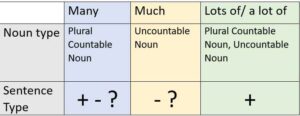
Examples-
He speaks many languages.
We didn’t drink much milk.
I have a lot of respect for her.
How much water do you need?
7. Generally, quantifiers come before the noun but they can also be used without a noun when it’s clear what we are referring to.
(सामान्यतः, परिमाणवाचक शब्द संज्ञा से पहले आते हैं, लेकिन जब यह स्पष्ट हो कि हम किसका उल्लेख कर रहे हैं, तो इनका प्रयोग संज्ञा के बिना भी किया जा सकता है।)
For example:
Do you need some milk?
Ok, I will have a little.
Here, ‘a little’ tells the quantity of milk. I am not using it with a noun because it’s clear that we are talking about the milk.
8. a lot of/ lots of, loads of, tons of, plenty of- all these quantifiers are used to express large quantities of something. They are all more or less synonyms, so they can be used interchangeably.
(a lot of/lots of, loads of, tons of, plenty of-ये सभी मात्रासूचक शब्द किसी वस्तु की बड़ी मात्रा को व्यक्त करने के लिए प्रयोग किए जाते हैं। ये सभी लगभग समानार्थी हैं, इसलिए इनका प्रयोग एक दूसरे के स्थान पर किया जा सकता है।)
She has a lot of/ lots of time.
She has loads of time.
She has plenty of time.
She has tone of time.
9. To determine which quantifier to use, you have to know noun that you are describing a quantity for is a countable noun or an uncountable noun.
(यह निर्धारित करने के लिए कि किस परिमाणवाचक शब्द का प्रयोग करना है, आपको यह जानना होगा कि जिस संज्ञा के लिए आप मात्रा का वर्णन कर रहे हैं वह गणनीय संज्ञा है या अगणनीय संज्ञा।)
Conclusion:
That’s all for today. I hope you have understood all the points made in this post (Quantifiers with Examples). If you found this post helpful, please share it with your friends and other students.
(आशा है कि आप इस post (Quantifiers with Examples) में बताए गए सभी points अच्छे से समझ गए होंगे। यदि आपको यह पोस्ट helpful लगा हो तो इस पोस्ट को अपने Friends और Other students को Share अवश्य करें।)
Read More Posts: